
Forty two years ago today we lost a winner.
He was the dominant driver of his era, winning two World Championships, in 1963 and 1965.
At the time of his death, he had won more Grand Prix races (25) and achieved more Grand Prix pole positions (33) than any other driver.
He also competed in the Indianapolis 500 five times, and won it once, in 1965.
I refer of course, to James Clark, Jr., OBE., better known as Jimmy Clark or the Wee Scot.
I got to know him through my time at Indy as a kid.
He was a quiet, gentle man, but certainly fan accessible, and always pleasant to spectators who reveled in watching him practice his craft.
His soft spokenness and gentle manner translated to his driving style, where his precision and care of the car became legendary.
The visionary Colin Chapman, head of Lotus Cars, chose Clark to pilot his small, fragile rear engined racers at the Indy 500, competing against the larger, more powerful, and more traditional roadsters of the day.

Jimmy Clark at Indy, 1965
The Indy regulars laughed and marveled at the tiny Lotus and its quiet pilot, assuring each other that the combination surely wouldn't last the 500 mile distance.
After all, the great AJ Foyt had won the race the year before in a traditional upright roadster.

AJ Foyt, Indy 500 Winner 1964
But on race day, Clark's gentleness with the Lotus made tire wear an advantage, and the handling of the rear engine car was more than a match for the front engined traditional roadsters.
At the end of the 500 miles, it was Clark and the Lotus covering the distance the quickest, and drinking the traditional bottle of milk in victory lane.
Jimmy Clark, and Lotus changed the history of the sport that day.
From that point on, no traditional Indy roadster won another 500.
And Clark opened the floodgates for European and South American drivers to have a shot at the 500 win from that point forward.
Clark achieved 33 pole positions and won 25 races from his 72 Grands Prix starts in championship races.
He is remembered for his ability to drive and win in all types of cars and series, including a Lotus-Cortina, with which he won the 1964 British Touring Car Championship; IndyCar; NASCAR, driving a Ford Galaxie for the Holman Moody team; Rallying, where he took part in the 1966 RAC Rally of Great Britain in a Lotus Cortina and nearly won the event before crashing; and sports cars.
He competed in the Le Mans 24 Hour race in 1959, 1960 and 1961, finishing second in class in 1959 driving a Lotus Elite, and finishing third overall in 1960, driving an Aston Martin DBR1.
He was also able to master difficult Lotus sportscar prototypes such as the Lotus 30 and 40.
Clark had an uncanny ability to adapt to whichever car he was driving.
While other drivers would struggle to find a good car setup, Clark would usually set competitive lap times with whatever setup was provided and ask for the car to be left as it was.
He apparently had difficulty understanding why other drivers were not as quick as himself.
After Clark's death, his father told Dan Gurney that he was the only driver Clark ever feared.
When Clark died, fellow driver Chris Amon was quoted as saying, "If it could happen to him, what chance do the rest of us have?
I think we all felt that. It seemed like we'd lost our leader".
Throughout his career, Clark was known to be encouraging to other drivers, including youngsters who aspired to the sport.
During my time at Indy when I was a kid, I saw Clark and spoke with him several times.
Once I told him of my desire to drive race cars, and he simply said "then go do it, but drive bad cars first, as there will be more bad cars than good cars in the long run".
A year after his death, I started my first race, in a Lotus Formula B car.
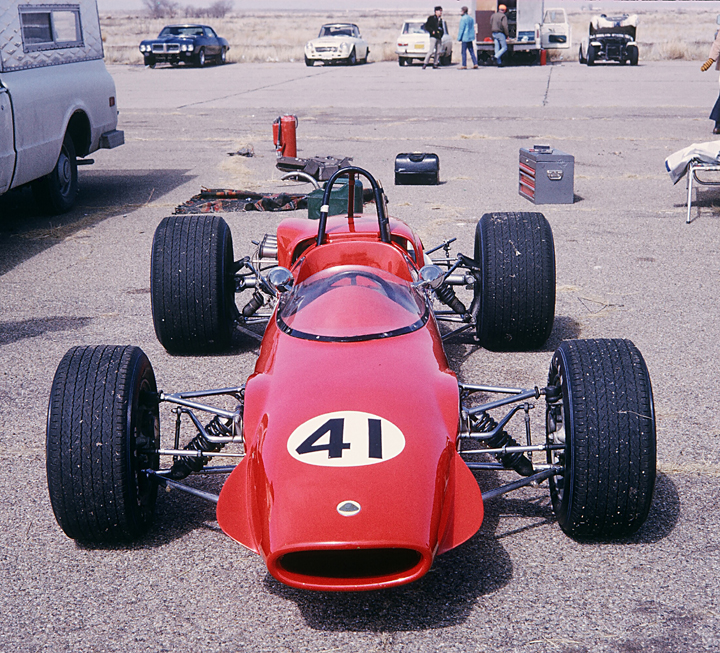
The Oldtimer's Lotus, in 1969, was similar to this sister car.
I wasn't.
“Mentor: Someone whose hindsight can become your foresight” ---- Roger Penske


